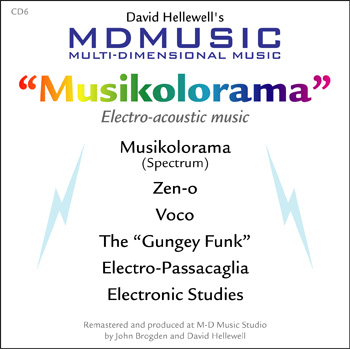
MUSIKOLORAMA
Audio CD - 14 Tracks
 |
TRACK LISTING
|
"Musikolorama" |
|
CD Total Running Time: 1 Hour 4 Minutes
Programme Notes
Composer David Hellewell was involved with electronic music synthesis at an early stage in its development. In the early 1970s he devised and originated a live Performance and Notation System for EMS (Electronic Music Synthesizers) for their VCS3 synths which were then in development.
“Musikolorama” (Spectrum) 1983, 25'00
This is an electro-acoustic work for a Light Show/Theatre/Dance based on the colours of the spectrum. It was originally commissioned by the Little Puppet Theatre, St. Agnes, Cornwall with funds provided by the Southern Arts Association. The work divides into 6 main sections or scenes, each of which is further subdivided into subsections of the continuous transmutation of the colours of the spectrum. These sections are:
1. Intro, Black, Grey, White 2. Blue, Turquoise, Green 3. Yellow, Gold, Orange
4. Flame, Red, Crimson 5. Violet, Magenta, Purple 6. Finale
The production and realisation, utilising live VCS3, other synths, acoustic piano and the then-new drum pad, was completed by the composer on 4-track tape in 1983, and remastered onto CD in 2005.
Zen-o 1981, 4'00
For solo VCS3 live, performed by the composer. A stark, ascetic Japanese haiku-like piece.
Voco 1981, 6'00
For solo VCS3 live, performed by the composer. With added bass drum - by thumping on the floor of his studio! The Vocoder, as it was called, was developed from the VCS3.
The “Gungey Funk” 1981, 10'00
This was an extremely complicated and dexterous piece to perform and record on live VCS3s. The complex harmonics and overtones derive from a single line melody which creates dynamic counter melodies and arpeggios. This became a unique feature of the piece. The ‘glottal thump’ later became the basis of the electronic and techno drum kits. The piece is ideal for theatrical, dance production, and was choreographed, produced and performed by members of the New Milton Drama Centre soon after it’s composition. There is a video of this production.
Electro-Passacaglia 1981-87, 8'00
This piece originated in 1981 as a work for electronic tape and live synthesizers. However, in 1987 the composer orchestrated the work for the existing electronics plus string orchestra. This considerably expanded the music and performance content without extending the original duration. In the classical baroque passacaglia, or chaconne, the variations occur over a repeated ‘ground bass’ figure. But in the Electro-Passacaglia this figure is in the higher registers of the string-like, bright and bell like synthesizers, with a “Twitter Rhythm” background of electronic sounds and effects. These are all, however, integrated into a thoroughly-modern and lush baroque-like composition of classical beauty and proportions, together with a counterpoint of both music and textures.
Electronic Studies 1975, 11'00
In 1975 Hellewell composed his ELECTRONIC STUDIES, a complex avant garde work for live VCS3 and Piano, as an artistic realisation of his new Performance System. Subsequently he used and developed this system in further advanced works he later composed, both in his popular works and avant garde creations. There are four Studies of greatly contrasting characters, each exploring the new sounds and capabilities of the new medium then in its infancy.